
Our subject lead for science is Mrs H Moffat.
We achieved the Primary Science Quality Mark (Gilt Standard) in September 2022, celebrating the quality of the Science curriculum at Russell. Our feedback was amazing!

-
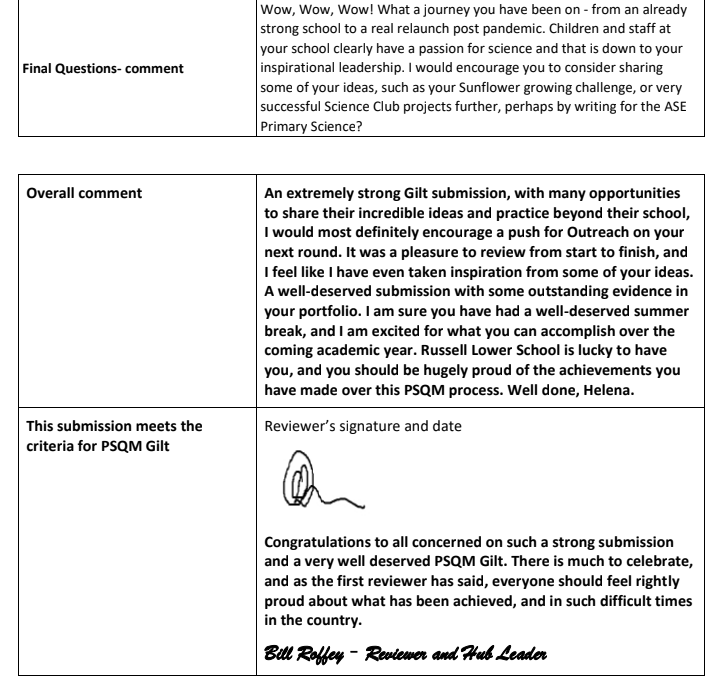
Look at the amazing feedback from our assessor.
The aims for our Science curriculum are taken from the National Curriculum and the Early Years Foundation Stage Curriculum (2021)
The national curriculum for science aims to ensure that all pupils:
- develop scientific knowledge and conceptual understanding through the specific disciplines of biology, chemistry and physics
- develop understanding of the nature, processes and methods of science through different types of science enquiries that help them to answer scientific questions about the world around them
- are equipped with the scientific knowledge required to understand the uses and implications of science, today and for the future.
Intent
Science is everywhere and here at Russell we aim for children to not only know what and why, but to also question their learning with a passion.
Our Vision and Principles were developed together in 2021 as part of our PSQM. These can be found at the bottom of the Implementation Statement.
We want the children to work things out for themselves. This is achievable when the pupils find a confidence within themselves but also when they are given equipment and resources and allowed to investigate before being taught. In this way, children experience misconceptions and solve them for themselves.
We try and link their learning with real life and make links with science capital whenever we can. For example, we have had a vet and a dentist making presentations to KS1 and engineers and IT technicians talking to KS2. In the past, a biologist visited and spoke to every class in KS2 with a collection of items such as owl pellets, honeycomb and a skull – again, the children were not told, they had to work out for themselves and their enthusiasm was tangible.
We aim to have good practical activities with wide ranging resources. This is especially true of our rocks and fossils, magnets and materials as well as a supply of torches, funnels, pipettes and thermometers to aid investigations. Tactile resources are important but these can play a secondary role when compared to our local surroundings.
The science curriculum is enriched by varied school grounds, with outside seating areas in and around Nathan’s Garden as well as a school garden. A community garden in Ampthill town as well as 156 acres of ancient woodland within walking distance, provide a rich habitat for learning about plants and living things and their habitats and all years regularly visit these areas. Year 3 have even collected seed for the Millennium seed bank in Ampthill Park (the ancient woodland) which was followed by a letter of thanks from Kew Gardens.
It is our intention to offer a broad, balanced and progressive curriculum for every child from Early Years to Year 4 through the use of Development Matters and the Early Learning Goals and the National Curriculum years 1 to 4.The Early Learning Goals explain how things work and why they might happen, children know and talk about the different factors that support their overall health and wellbeing and explore the natural world around them.
We want children to feel excited about their science learning in school. Outside of routine lessons this is achieved by holding one off events such as having visitors in school, clubs, visits or activity mornings, which are sometimes solely science based.
Teachers subject knowledge is re-enforced by curriculum maps which allow all staff to see objectives for each year as well as prior and future learning. We firmly believe that it is not just about listening in the classroom, it is about the what if approach we offer to really inspire our children and let them lead.
Implementation
Our science curriculum has been carefully designed to focuss on curriculum sequencing to ensure skill progression from lesson to lesson and year to year with a focus on deepening and embedding key learning, knowledge and skills. Year group milestone documents are in place order to support the above and assessment within the subject.
We have developed year group and subject specific curriculum plans which identify when the different subjects and topics will be taught across the academic year. The vast majority of subjects are taught discretely however staff make meaningful links across subjects through themes. For example, in year 1 where Everyday Materials is taught with the theme Super Heroes where the children were able to test a variety of materials to see how waterproof (absorbent) they were.
Within science we focus our teaching on the subject content outlined within the National Curriculum programme of study.
Each year pupils progressively build their skills and knowledge and can link prior skills and knowledge to new learning to deepen their understanding (a cumulative curriculum). For example, progression in plants can be seen across the years:
Early Years: plant seeds and care for growing plants and understand the basic life cycle of the plant.
Year 1 identifies common wild and garden plants and the structure of these plants.
Year 2 look at what plants need to survive and understand how seeds and bulbs mature into plants.
Year 3 study the functions of different parts of the plant as well as how water is transported through the plant.
Year 4 use all prior knowledge and use classification keys to classify groups of plants.
Within all lessons we are working towards Rosenshine’s 17 Principles of Effective Instruction and use of the Great Teaching Toolkit. Short-term plans are developed by using the Primary National Curriculum for Science. This science national curriculum sets out statutory requirements for each unit and also give notes and guidance which are non – statutory. Teachers are therefore able to plan their lessons using suitable resources and websites of their choice. Within science lessons we are working towards children being able to experience and observe phenomena and observe the natural and human constructed world around them. They are encouraged to be curious and ask questions and use scientific language.
Scientific Enquiry
Children are encouraged to learn by using five different types of scientific enquiry:
Observing changes over time, noticing patterns, grouping and classifying, carrying out fair and comparative tests and using secondary sources of information. This ensures a wide variety of scientific methods, processes and skills are used in their learning.
Working scientifically is described separately in the programme of study but we teach it continuously through the science content of lessons.
Within the lessons, prior learning from the unit and previous units is consolidated through re-cap and reinforcement to ensure children can make links between skills/knowledge and previously learnt skills/knowledge. Teachers start their lessons by asking what the children have learnt in previous lessons using specific questions from last week/ last term/ last year. These questions prompt the long-term memory and are invaluable.
Questioning, modelling and feedback are used to support the teaching and learning process, ensure progression within every lesson and aid assessment. Children are encouraged to explain scientifically and this starts in foundation when these pupils learn to articulate their ideas and thoughts in well-formed sentences.
Pupils participate in high quality science lessons, ensuring practical investigations, observations, a variety of resources and outside learning is encouraged.
At Russell Lower we value the use of the outdoor environment to support learning for example Foundation Stage complete a mini beast hunt in the school grounds, year 1 study the seasons outside and walks further afield are invaluable such as year 3 seed collecting in Ampthill Park.
Staff are also supported and encouraged to make cross curricular links between science and other areas such as when Year 1 create a bar chart to show rainfall in a week as they carry out a comparative test and Year 4 use Carroll diagrams to classify animals.
Science at Russell allows children to broaden their scientific view of the world around them. They explore, they test and they develop ideas about the relationship of living things and familiar environments. They ask questions to help them make informed decisions. We provide a wide variety of opportunities, visits, visitors and activities.
For example:
- Early Years visit the Kings Arms Gardens in Ampthill to support their learning of exploring the natural world around them, making observations and drawing pictures.
- Year 1 are visited by the RSPCA. The children a variety of animals and their knowledge of lifecycles is reinforeced. The activities also reinforce their understanding of carnivores, herbivores and omnivores.
- Year 2 visit Marston Community Forest site and experience the vast open water area with sparse woodland planting and lakeside vegetation. They explore and learn about animals on the land and in the water. This reinforces the children’s learning about habitats including micro habitats and is a foundation for their work on food chains.
- Year 3 visit Celtic Harmony as part of their Sensational Stone Age theme. The wooded area where life in the stone age time is re-created also allows children to see how plants survive in a natural habitat and how parts of plants can be used in building. Knowing that soils are made from organic matter is very clear on this trip and thus enforces learning from rocks and soils. Year 3 also take part annually, in live online workshops, with the Royal Parks.
- Year 4 experience Wimpole Farm which links with their theme of Memory Box. This links with living things and their habitats and the animals and plants on the farm are discussed when learning about classification. During the WWI trail, year 4 also learn that environments can change.
- Each child in school is given a sunflower seed to plant at home and enter into the tallest sunflower competition and every class grow tomatoes and other vegetables. Gardening club also grow a variety of flowers and vegetables.
- Teachers continue to provide learning which is hands on and develops science capital.
Long and medium term plans
Impact 2025/26
In order to measure the impact of our science curriculum we use a range of formative and summative assessment in all lessons such as:
- Questioning
- Pupil, parent, staff voice/questionnaires
- Observations/learning walks/drop ins
- Analysis of our assessment tool linked to milestone documents/National Curriculum for each year
- The use of PLAN assessment lesson opportunities as part of formative assessment
- Summative assessment
Assessment information is collected frequently and analysed as part of our monitoring of teaching and learning cycle. This process provides an accurate and comprehensive understanding of the quality of education in science as well as indicating areas for development.
Academic outcomes and impact:
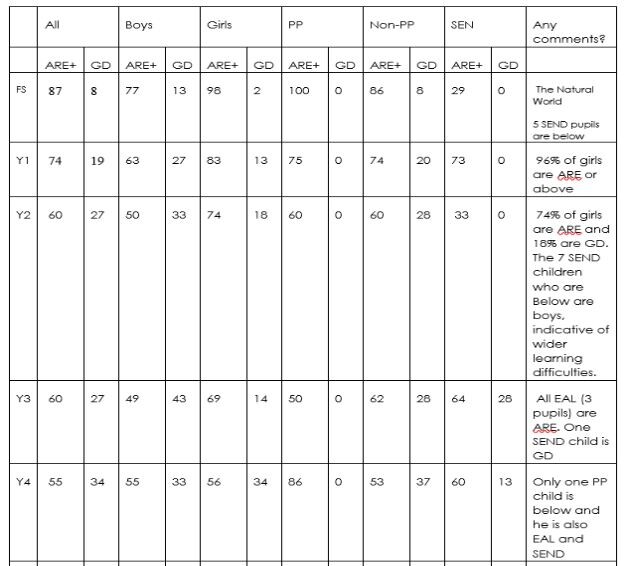
For this year we are aware of the following outcomes for science: (shown as %)
Key findings:
- Girls are performing well in all age groups, especially year 2 – 92% and year 4 – 90%.
- All EAL in year 3 are ARE and 1 SEND child in year 3 is GD, indicating quality first teaching.
- Year 2 – the 7 SEND children who are Below are boys, indicative of wider learning difficulties because 92% of girls are ARE or above.
- The highest proportion of GD are in year 4 indicating children are able to build on previous years learning each year.
- Year 3 pupil voice (January 2026) The three year 3s used scientific language to describe metal / carpet. They knew attract / repel without prompting and gave a long description about light and shadows. When asked what they wanted to be when they grew up and what science they would need, they answered: Author or illustrator – paper – opaque – trees – plastic bottle. Dancer – healthy foods – teeth – milk dairy. Their learning is having an impact.
- Year 2 pupil voice (January 2026) There was content knowledge as well as procedural knowledge as the children informed me of foods which give us healthy teeth and bones and then after having discussed food chains, they could make up another, using different animals using Arctic animals from the year's theme. The year 3s knew that healthy foods would be what they need to be a footballer and a gymnastic teacher - taking their learning into their lives.
Key actions:
- Consider how to raise the seven SEND year 2 children from below to ARE.
- Encourage the use of graphic organisers and keep them on display in classrooms.
- Use science in cross curricular work.
- Encourage the use of PLAN Primary Science resources to KS2 and year 2 to try the learning activities to increase ARE and GD percentages.
- Keep staff informed of activities on Explorify.
Science at Russell is always so tangible and practical and together with outstanding teaching, has allowed for the expected successes in 2025 – 2026.
Other outcomes and impact:
Detailed and clear planning allows for continuation and progression across the year groups. This is seen particularly in plants and everyday materials as well as animals including humans.
Year 1 identify common and wild plants as well as deciduous and evergreen trees. Year 2 describe how seeds and bulbs grow into mature plants as well as identify the requirements for plant growth. This leads on to year 3 describing the functions of different parts of the plants as well as looking at pollination and knowing how water is transported up the stem. Year 4 then find different ways of classifying plants such as flowering and non-flowering. Key words such as deciduous. Evergreen are repeated in lessons through the school years.
Science Week (March 2026) involved a lot of parents, especially from years 1-3, coming in and presenting workshops for the children including follow up visits to assess predictions.
At Russell Lower we have obtained the Primary Science Quality Mark three times, (this award lasts for three years). In 2014 the silver award was achieved and in 2018 Russell achieved the Outreach award. In September 2022 we achieved Gilt (formerly known as silver) and we have submitted documents for the Gilt award again in July 2026.
Visits and visitors have been ongoing this academic year:
Foundation: Kings Arms Garden, Herrings Green Farm.
Year 1: Woburn Safari Park, Herrings Green Farm visited.
Year 2: Marston Vale Community Forest, Whipsnade Zoo
Year 3: Celtic Harmony
Year 4: Ampthill historical walk and Historic Workshops, linked to sound and states of matter.
Milestone example
-
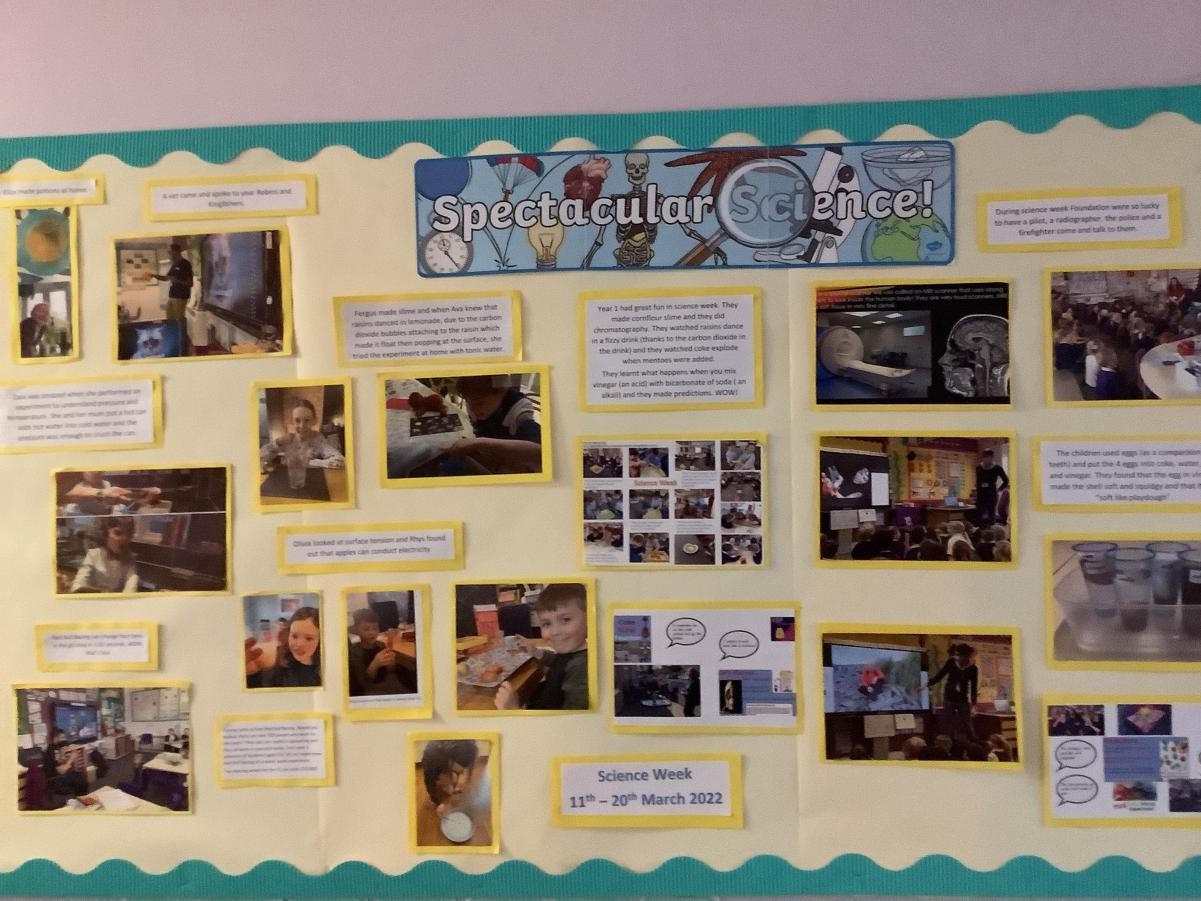
A compilation of our Science Week visitors and activities. We certainly smashed a few stereotypes!
-
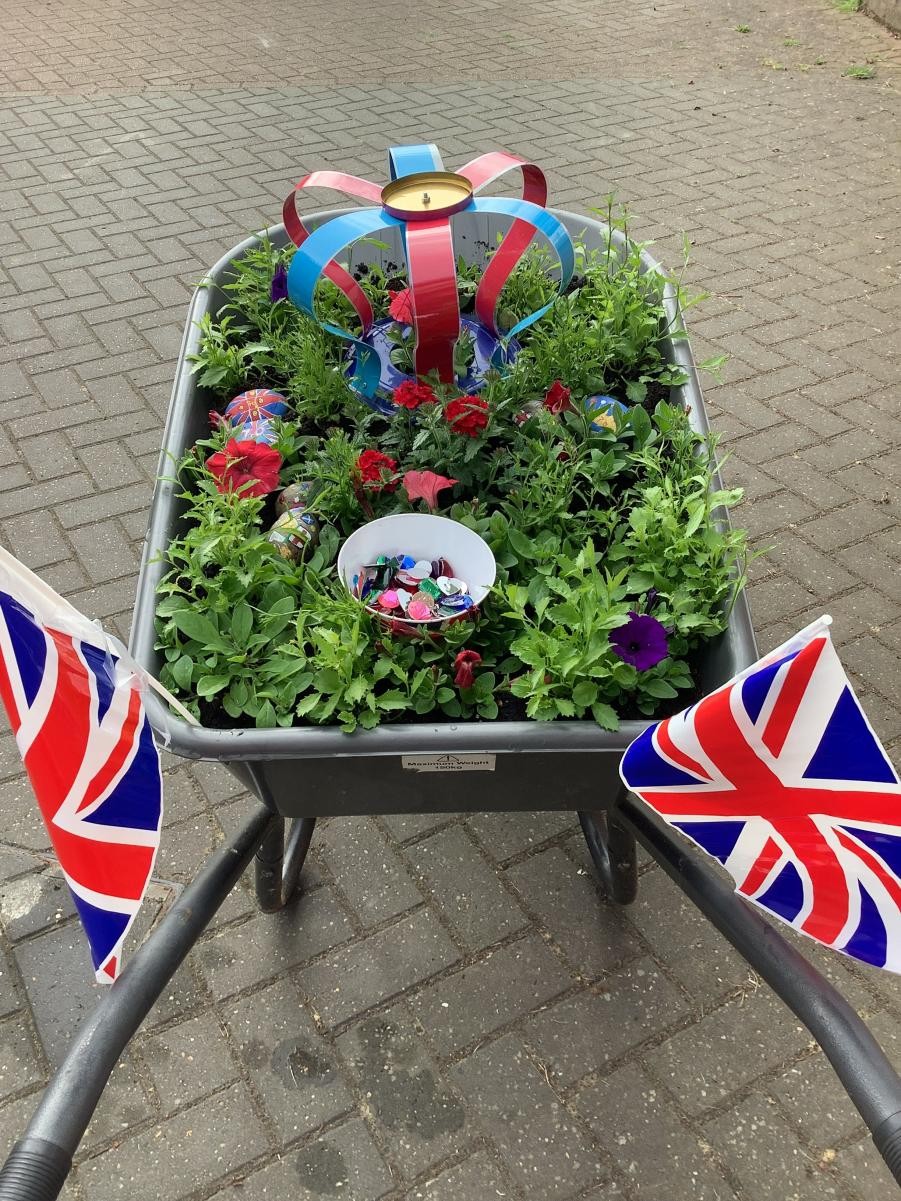
Russell Lower School Gardening Club entered the 2022 Swiss Garden (Shuttleworth) wheelbarrow competition with a Jubilee inspired entry. May 22
Our Eco Code:
Russell Lower School is an Eco School and below you will find our Eco Code